
Author
Carl Paulse
Share
In real estate, margins have never been managed in dashboards.
They’re managed through discipline.
Close the books. Review the numbers.
Then ask: What happened?
That answer doesn’t live in a system.
It lives with people.
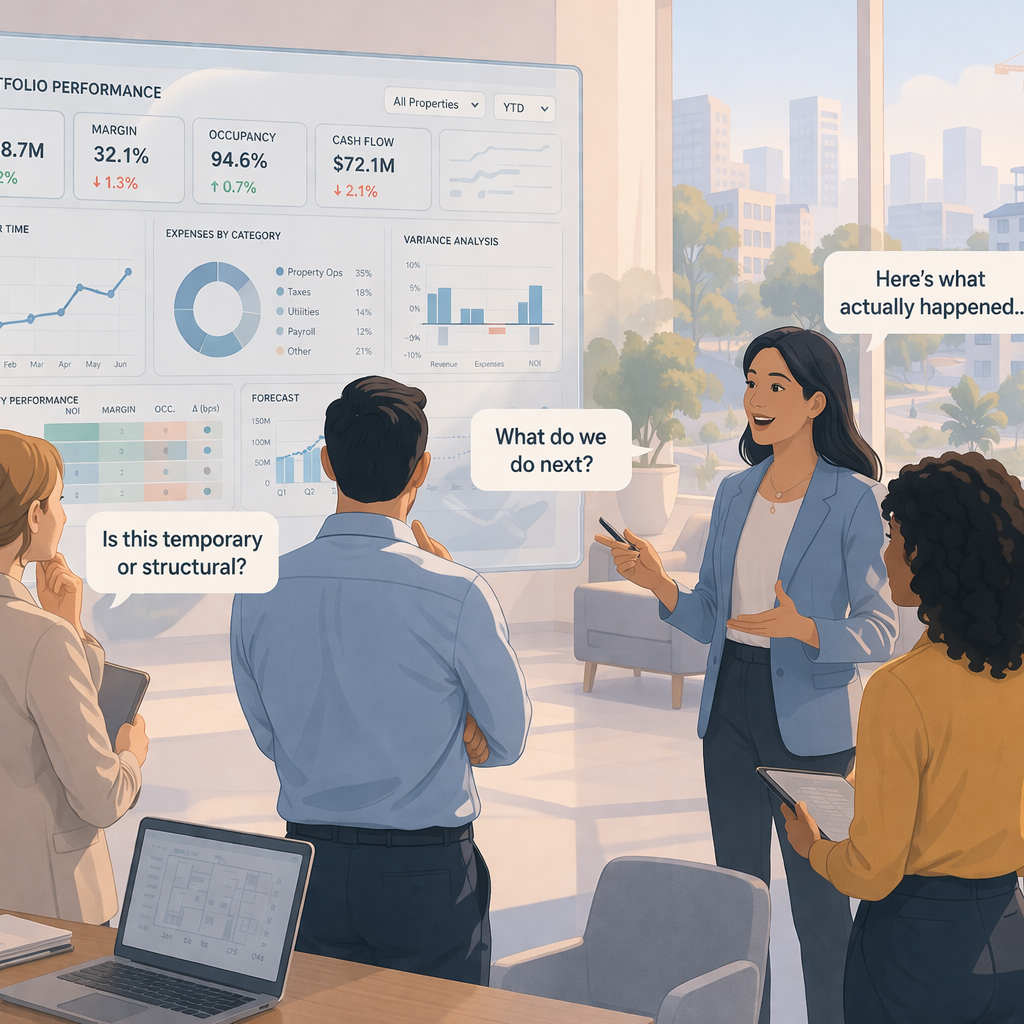
A property manager explains. An asset manager adds context. Finance connects the dots and identifies what matters.
No matter how good the data is, understanding a property has never been just about numbers.
This is why BI has never solved it.
It shows you what changed.
It doesn’t tell you why it matters or what to do next.
So the real system continues to live elsewhere.
In spreadsheets.
In conversations.
In a fragmented context that gets rebuilt every month.
And for a long time, the discipline and routine of this approach worked.
But portfolios have grown and expectations have increased.
And what once felt rigorous now often feels fragmented.
But, the underlying belief holds true:
Performance is understood through human explanation.
So, what if nothing about that belief had to change…
except giving it a structure that allows it to scale?
Where context carries forward.
Where explanations connect decisions and actions across time.
Because dashboards don’t improve margins.
Decisions and actions do.
And that’s where finance creates leverage.
That’s the real opportunity.

In real estate, margins have never been managed in dashboards.
They’re managed through discipline.
Close the books. Review the numbers.
Then ask: What happened?
That answer doesn’t live in a system.
It lives with people.
A property manager explains. An asset manager adds context. Finance connects the dots and identifies what matters.
No matter how good the data is, understanding a property has never been just about numbers.
This is why BI has never solved it.
It shows you what changed.
It doesn’t tell you why it matters or what to do next.
So the real system continues to live elsewhere.
In spreadsheets.
In conversations.
In a fragmented context that gets rebuilt every month.
And for a long time, the discipline and routine of this approach worked.
But portfolios have grown and expectations have increased.
And what once felt rigorous now often feels fragmented.
But, the underlying belief holds true:
Performance is understood through human explanation.
So, what if nothing about that belief had to change…
except giving it a structure that allows it to scale?
Where context carries forward.
Where explanations connect decisions and actions across time.
Because dashboards don’t improve margins.
Decisions and actions do.
And that’s where finance creates leverage.
That’s the real opportunity.